
Before even a shovel of dirt was tossed, plans for this Interstate go back to the original routes for the Interstate System as unveiled in 1957. Originally, this highway would have been a part of an Interstate 82 which would have followed this alignment and the current Interstate 80 to connect Scranton and New York City. However, revisions to the map were made and it was replaced with Interstate 81S on this alignment with a rerouted Interstate 80 the remainder of the way.
No matter the designation, this route provides a high-speed connection for traffic heading between New York City and the Southern Tier of New York state, as well as connecting the Tobyhanna Army Depot to the Interstate System. Construction on the earliest section of this Interstate began in 1961 between Interstate 81 in Dunmore and East Drinker Street south of Dunmore. Technically built as an upgraded US 611 to relieve Dunmore from traffic on East Drinker Street, this section opened in 1962.
The next section to see construction was between Interstate 80 and PA 940 in 1964, which was being built in conjunction with work taking place on the section of Interstate 80 to which it connected. That section of Interstate 81E opened the following year. It'd be a few years until construction began on the next portions, those being the ones between PA 940 and PA 423 southwest of Tobyhanna and PA 507 to the Dorantown Road overpass. Work on the former started on February 20, 1967, and the $3.8 million, 5.22-mile-long section opened to traffic in the fall of 1968.
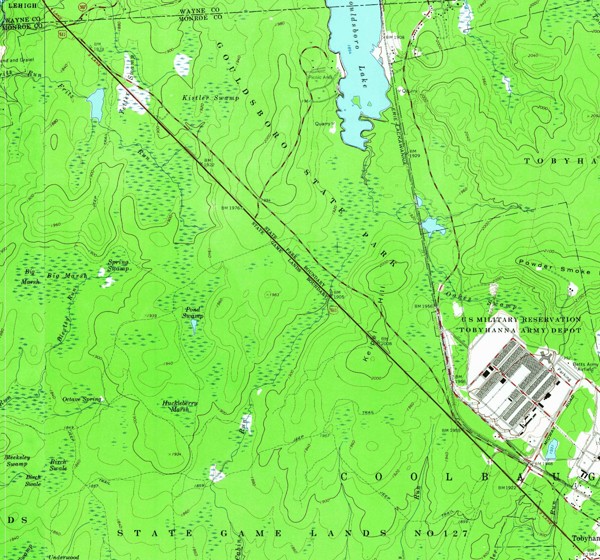
Also in 1968, work began between the Dorantown Road overpass and PA 307 and on upgrading the US 611 alignment between PA 423 and PA 507 to serve as Interstate 81E's northbound lanes. In states out west and in the Great Plains, it was commonplace to use an existing roadway and just lay down another set of lanes on either side, but virtually unheard of in eastern states due to the frequency of houses and businesses along its roads. However, there were none of either because the roadway straddled Gouldsboro State Park to the northeast and state game lands to the southwest.
 |
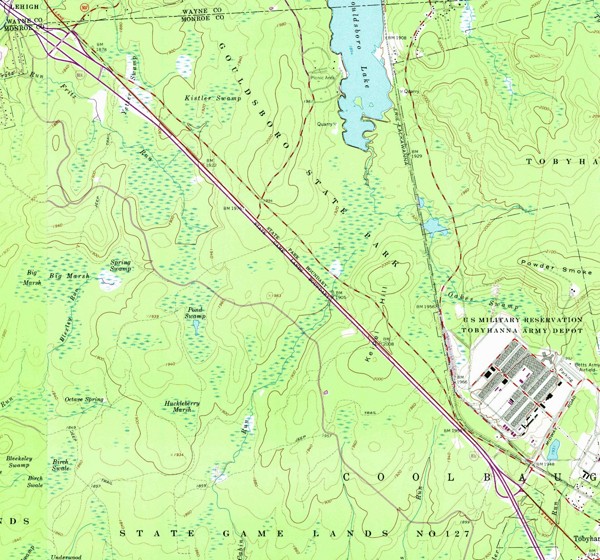 |
| The route of US 611 in 1965 (left) and the former route in 1973 (right) between PA 423 and PA 507 in the Tobyhanna area. Interstate 81E's northbound lanes were the former US 611 right-of-way, while its original alignment paralleled both to the northeast. (United States Geologic Survey) | |
On November 21, 1969, the long stretch of Interstate 81E that had been under construction between PA 423 and PA 307, including the upgrading of US 611 between PA 423 and PA 507, for the previous two years opened to traffic. Ribbon-cutting ceremonies for the $7.1 million piece of Interstate 81E were officiated by Department of Highways Secretary Robert G. Bartlett and held in Covington Township in Lackawanna County.
The 1970s saw construction continue on the right of way with work to upgrade the original US 611 alignment between the Drinker Street interchange and US 611 where it intersects from the east at the beginning of the Roaring Brook valley starting in 1971. However, the designation would not live to see that work completed.
In May 1972, the Department of Transportation applied to the American Association of State Highway Officials to eliminate Interstate 81E and replace it with the Interstate 380 designation. The biggest reason was to avoid confusion at the interchange with Interstate 81 outside Scranton, where drivers would have to differentiate between Interstate 81 and Interstate 81E markers. PennDOT referenced a similar issue at the junction of Interstate 80 at the Ohio Turnpike where they intersected Interstate 80S west of Youngstown. Other reasons included route continuity, an improvement in terminal city selection, and a better arrangement of the milepost exit numbering sequence. The latter was spurred by a simultaneous application to have Interstate 84 multiplexed between Interstate 81 and the future interchange west of Elmhurst when Interstate 84's originally proposed path over the Moosic Mountains was cancelled over environmental concerns. In his letter dated May 3, 1972, Secretary of Transportation Jacob G. Kassab suggested the Interstate 380 designation for that reason, because the mile-markers for both routes would start at their shared terminus with Interstate 81.
The American Association of State Highway Officials' US Route Numbering Committee approved PennDOT's application to redesignate Interstate 81E as Interstate 380 at their meeting on June 19, 1972, with approval by the Executive Committee coming the following day. Work to change out the Interstate 81E markers for Interstate 380 markers continued up to June 1973.
While work to change the old Interstate 81E markers to Interstate 380 markers continued into 1973, that same year the upgrades to the original US 611 alignment between Drinker Street and the interchange that marks the northern terminus of PA 435 were completed. In 1974, construction began on the Interstate between the PA 307 interchange and the Blue Shutters Road underpass. The following year, in 1975, construction began from the latter to the PA 435 interchange, which included the "Directional T" interchange with Interstate 84. That same year, mileage-based exit numbers first appeared on the roadway. Both sections opened to traffic in 1976 and marked the completion of a high-speed link between Scranton and Delaware River Valley. The exit numbers would change from mileage-based to sequential in 1978.
Winter weather can play havoc on roads in the Poconos, and one celebrity found that out the hard way. The tour bus of Gloria Estefan, lead singer of Miami Sound Machine, was hit by a truck in the northbound lanes near Tobyhanna around 12:15 PM on March 20, 1990, en route to a show in Syracuse, New York. She, five other band members, and the truck driver were taken to Community Medical Center in Scranton. Estefan suffered two fractured and dislocated vertebrae and fortunately was not paralyzed from those injuries, but did require two titanium rods to be surgically implanted to stabilize her spinal column. Her husband, Emilio, suffered head and hand injuries, and their son, Nayid, suffered a neck injury. The bus driver, Ron Jones, stopped the vehicle when he saw a tractor-trailer jack-knife in the snow and a truck and bus stopped behind. "The road was wet and snow-covered," said Pennsylvania State Police Trooper Joseph Kearney, the second officer on the scene. "It was light snow at that time and slippery. Traffic had stopped." He added, "He (the truck driver) came up on them and was unable to stop. He was unable to stop and should have been. That's the bottom line." The truck driver was cited for driving at an unsafe speed. A lawsuit was filed in April of that year against the driver, Heraldo Samuels, but it was settled in August 1990 for $8.5 million. Estefan had to cancel an international tour to recuperate and endured ten months of physical therapy.
In 1995, the parking areas that were located on the southbound side at mile marker 16 and the northbound side at mile marker 14 were closed and have since been repurposed into weight stations.
Since the inception of the Interstate 380 designation, it was signed as an east-west highway. In May 2001, during the conversion of exit numbers from sequential back to mileage-based, PennDOT switched the cardinal direction of the highway to a north-south orientation so that the exit numbers would begin at the interchange with Interstate 80 and to comply with Federal Highway Administration guidelines for spurs branching off of east-west Interstates. Without the change, the exit numbers would have begun at Interstate 81 outside of Scranton.
One of the grisliest murders in the history of the Poconos had one of its final chapters written on Interstate 380. On January 29, 2008, a PennDOT crew treating the Interstate in preparation for freezing rain discovered a bag in the median at mile marker 4.1. The bag contained human remains, which upon discovering, the crew contacted State Police. Interstate 380 was closed in both directions with traffic detoured onto PA 940 and PA 611 while more than 25 officers searched the area. Bags were found at five more locations along this Interstate and two locations along Interstate 80 in Monroe County. An autopsy was performed, and the remains were identified as those of Deanna Null of Williamsport. Charles Hicks of Tobyhanna, and who was employed at the Tobyhanna Army Depot, was arrested and put on trial for the murder.
We all know why the chicken crossed the road, and it seems at least 250 of them knew as well on the morning of September 6, 2012. State Police and PennDOT were sent out to a section in Dunmore after receiving calls from drivers who spotted chickens running free and more than a dozen crates filled with chickens on the side of the Interstate. No one knows how the chickens got there, but it was more than likely a truck hauling chickens that somehow lost its load without the driver knowing. The Interstate was not closed because the chickens were resting off to the side of the travel lanes. Department of Transportation workers gathered and delivered them to the Griffin Animal Pond Shelter in Clarks Summit.
At a ceremony held on the Turnpike to unveil its initial 70 MPH speed limit zone on July 23, 2014, Transportation Deputy Secretary Brad Mallory announced that on August 11, the speed limit would increase on Interstate 380 as part of a pilot project. The Act 89 transportation bill passed in November 2013 gave PennDOT the power to raise speed limits on their highways to a maximum of 70 MPH. While "lead foots" rejoiced, not everyone was happy about the rise including State Representative Mario Scavello. At a meeting of the Safe 80 Task Force on July 25, he said that PennDOT needed to examine the traffic impact of the Kalahari water park complex under construction at Pocono Manor. They took his suggestion as only 16 miles of Interstate 380 were affected from north of Exit 8 (instead of Exit 3 originally planned) in Monroe County to Interstate 84 in Lackawanna County. The new speed limit signs were installed by the end of that day.
After traffic and weather taking a toll on them, a project began in 2019 to replace the twin bridges over Roaring Brook and the active Delaware, Lackawanna and Western (DL&W) Railroad as well as reconfiguring the PA 435 interchange from a left-hand side exit to a standard right-hand side exit. The first phase of work was the building of a 12-foot travel lane in the median on the eastern side of the southbound bridge. Once it was opened and traffic shifted onto it, the right lane on Interstate 380 was closed to traffic and became a staging area and temporary access road. Also included in Phase One was preparing the project site for construction of several access roads, staging areas, crane pads, and temporary stream crossings of Roaring Brook for access, construction, and removal of the original bridges. Detention basins, drainage ditches, and a drainage network were built to control water runoff from the Interstate and project site.
Construction began on the piers for the southbound bridge over Roaring Brook and the Delaware, Lackawanna and Western (DL&W) Railroad line in 2021 and concluded in fall of that year. Phase Two consisted of building a new southbound roadway and bridge on the new alignment in the median between the original northbound and southbound roadways which began in 2021 and stretched into 2022. Drainage, guide rails, permanent signage, and Intelligent Transportation System/CCTV system equipment installation was included in this phase, as well as construction starting on the PA 435 interchange reconfiguration which concluded in the fall of 2022. The new southbound bridge opened to traffic in late 2022.
Phase Three consisted of demolishing the exiting southbound bridge and starting construction of the remaining portion of the new bridge and roadway which began in 2022 and last into 2023. Due to the size of the beams and how close they were to the new bridge, the demolition of the old one had to be done very carefully. "There's a lot of engineering calculations that go into where you got to pick the beams because if you don't pick them the right way, it can tip the crane over, so it's a lot of engineering calculations that go into being able to pick up a beam like this," said PennDOT official Harold Hill. It was also during this phase that construction of the new "flyover" ramp for PA 435 began. The original exit closed on November 28, 2023, to prepare for the work to reconfigure the interchange.
After 332 days, on October 24, 2024, the PA 435 exit from Interstate 380 officially reopened. During the closure, drivers had to endure an eight-mile-long detour. "The last 330 plus days, they’ve been taking that eight-mile detour, which puts them out of their way. So now they'll be able to make the direct connection between 84 and 435, so that's just going to inherently make this area safer," said Richard Roman, PennDOT District 4 Executive. The change from a left-side exit to a right-side exit was touted by the district executive. "When you travel the interstate around our country, you expect the exits to be on your right, and it makes for a safer environment and safer roadway. We're pleased to have this done," said Roman. The interchange which now features 14-foot-wide lanes, wider shoulders, and a safer curve to PA 435 cost $10.5 million. Contractor J.D. Eckman and subcontractor Kriger Construction were able to reopen the interchange within their time frame and three days ahead of schedule.
Not long before the northbound bridge opened, fifth and sixth grade STEM students from Mid Valley Elementary Center in nearby Throop visited the construction site on October 28, 2025. It had been a two-year process for students interested in STEM, and for the previous five years, sixth grade math teacher Sean Sholtes had been bringing fifth graders to the work site and then back again in sixth grade. "Going every year and seeing the progress, and now it's close to being done. We were there pretty much when it started, just to see that process is pretty incredible," said Sholtes. "A lot happened and there was so much differences and I love it," said sixth grader Payten Stoffel. The returning students could not believe the changes that had taken place from the previous year's visit. "Last time we were here, it was the beams and the piers, and there was no top, just the beams. This year, there was a whole road and stuff, and I'm like 'How did it change so much in a year?'" said Maximus Morano. The purpose of the field trip is to give students already interested in civil engineering an experience of visiting a working construction site and to see the bridges from below and above. "We see it daily, but when you talk to these fifth and sixth graders with how amazed they are with the work that we do, I think it's eye-opening that these are the future of engineers and leaders within this industry," said Kaitlyn Drumheller, PennDOT District 4 Maintenance Services Engineer. After their trip to the site, the students went to the PennDOT District 4 office in Dunmore to review design aspects of the project and to learn how it goes from the drawing boards to construction.
The northbound bridge opened ahead of schedule to traffic on December 18, 2025, signaling the end of the $118 million project.
Early reopen alert!
— PA Department of Transportation (@PennDOTNews) December 19, 2025
This week, our northeast PA team reopened the westbound portion of Twin Bridges in Lackawanna Co., which carry I-84 over a trail corridor & an abandoned railroad bridge, completing this 5-year project ahead of schedule.
More info: https://t.co/TXvOGrZjps. pic.twitter.com/DbNVz8miKL
|
 INFORMATION
| Southern Terminus: | I-80 at Exit 293 in Crescent Lake |
| Northern Terminus: | I-81 at Exit 187 in Dunmore |
| Length: | 28.15 miles |
| National Highway System: | Entire length |
| Names: | Scranton-Dunmore Expressway: Exit 2 to I-81 Fallen Trooper Memorial Highway: Exit 2 to I-81 Pocono Expressway (former) |
| SR Designations: | 0380 0084: Exit 24 to I-81 in Scranton |
| Multiplexed Route: | I-84: Exit 24 to I-81 |
| Counties: | Monroe, Wayne, and Lackawanna |
| Emergency: | 911 |
| Advisory Radio: | None |
Former Designations: |
PA 2 (1925 - 1928): Exit 2 to Exit 1 US 611 (1928 - 1972): Exit 2 to Exit 1 I-81E (1964 - 1972) US 611 (1962 - 1972): Exit 2 to I-81 PA 435 (1971 - 1976): Exit 2 to I-81 US 611 (1970 - 1972): Exit 8 to Exit 13 |
| Former LR Designations: | 1002: I-80 to PA 435 168: PA 435 to East Drinker Street on-ramp 790: East Drinker Street on-ramp to I-81 |
| Links: | Exit Guide Interstate 380 Ends Interstate 380 Pictures Interstate 81E (Decommissioned) Interstate 81S (Decommissioned) US 611 (Decommissioned) Interstate 380 - Andy Field/Alex Nitzman Interstate 380 - David Golub Interstate 380 - Scott Oglesby Interstate 380 Photos - Doug Kerr Interstate 380 Photos - Valerie Deane Interstate 380 Pictures - Andy Field/Alex Nitzman Interstate 380 Pictures - Steve Alpert |